
Agents
Governed identities, not anonymous API callers
Platform architecture
Beyond chat. Built for governed operations.
What we controlProduction AI needs more than model access. Aintlijx governs the operational primitives around execution: who can act, what tools are allowed, how workflows run, what credentials resolve, what it costs, and what evidence is preserved.
Governed identities, not anonymous API callers
Structured execution with policy gates
Registered capabilities with scoped access
Users, service accounts, agents, roles
Organization, workspace, environment boundaries
Product-scoped permissions
Vault-backed credential resolution
Correlation across services and execution
Evidence-oriented execution records
The core platform is runnable in real environments and being validated with design partners. This is in active testing—not self-serve general availability.
Gaps remain in tenancy enforcement breadth, certification, and self-serve onboarding—we label maturity honestly rather than overclaiming general availability.
The customer product is a four-tab workspace. AI Helper is on every screen—it explains and suggests; it does not mutate. Code changes go through Composer, inside Build.
Clarify intent and produce a governed plan
Edit, terminal, and Composer
Project vaults and cited context
Inspect execution, changes, and cost
| Layer | Role |
|---|---|
| Experience | Four-tab workspace (Plan, Build, Knowledge, Runs), AI Helper, and product surfaces on shared governance |
| Control plane | Agents, workflows, composer, policy, and orchestration |
| Execution | Tool gateway, sandboxes, credential resolution |
| Identity & tenancy | IAM, organization context, product-scoped RBAC |
| Data & evidence | Audit, prompt logs, cost metering, trace correlation |
| Infrastructure | Kubernetes-native services, secrets, networking |
Services are designed to compose: identity establishes who is acting; tenancy scopes what they can touch; agents and workflows execute with tool and credential policy; observability and audit capture what happened end to end.
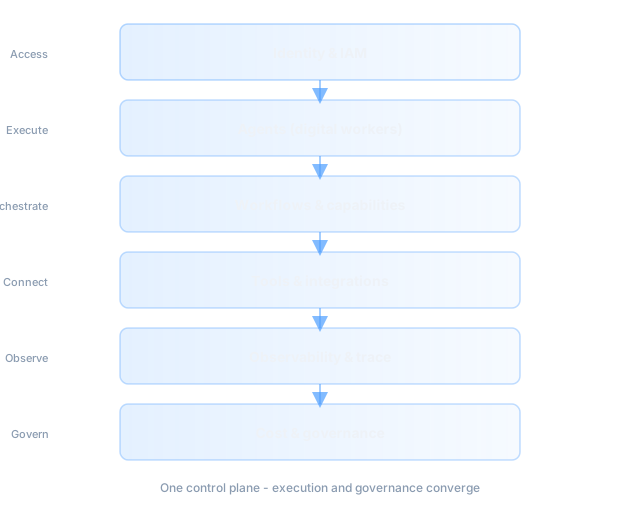
One control plane — execution and governance converge.
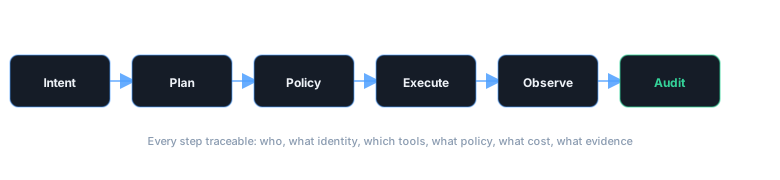
Intent → Plan → Policy → Execute → Observe → Audit
Every meaningful action should be traceable: who requested it, which identity executed it, which tools were used, what policy applied, what it cost, what changed, and what evidence was produced.
Aintlijx is designed for both dedicated single-tenant environments and multi-tenant platform operation. Organization context propagates across HTTP, service-to-service calls, and async workers—resolved once, verified at the boundary, enforced in data paths.
Workspaces represent dev or operational environments within an account. Product surfaces inherit the same boundaries rather than inventing per-app tenancy.
Agents are not opaque model calls. They run as identities with tool permissions, credential policy, cost budgets, and audit obligations—the same discipline expected of human operators and service accounts.
Roles are scoped to products, workspaces, workflows, tools, secrets, and audit visibility—not one global admin for everything.
| Role | Typical scope |
|---|---|
| Platform admin | Organization settings, members, billing visibility |
| Security admin | Secrets, policies, tenant isolation, access reviews |
| Product admin | Product surface configuration and entitlements |
| Agent operator | Run and monitor agents within policy bounds |
| Workflow approver | Reviews and approves sensitive execution paths |
| Developer / builder | Workspace access, tool usage, workflow authoring |
| Auditor | Read-only access to execution and audit evidence |
Clarify intent in Plan, execute with approved tools in Build, keep context in Knowledge, and inspect outcomes in Runs. Policy, identity, and audit stay on the control plane. This is the design-partner studio—not a claim of general availability.
Aintlijx control plane
In active testingObservability & governance
In active testingCustomer workspace & AI Helper
In active testingProduct surfaces
PlannedIn active testing — built enough to test seriously; not broadly released. In development — being actively built; not yet testable as a public product. Planned — on roadmap; not implemented yet.